

Tiny Machines
Tiny Machines Part 2: Making Tiny Machines
Nerd Out


It’s all very well knowing about nanoparticles, but for scientists and engineers to study them and make them useful it helps to see and manipulate them. How do they do this?
Nanotechnology really took off as a field in the 1980’s with the invention of two important pieces of technology – the scanning tunneling microscope (STM) and the atomic force microscope (AFM). These are not your ordinary school lab microscopes.
Both microscopes make use of a very fine special tip. The biggest difference between the two is that as the STM tip moves across the sample, a tiny electric current flows between the atoms of the sample and the tip. In an ATM, as the tip moves across the sample it is attracted or repelled by the atoms and this movement is recorded.
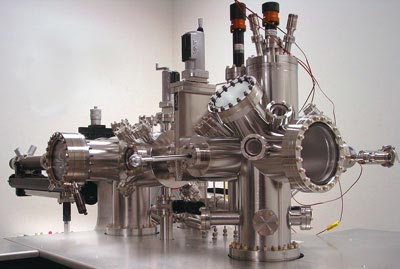
Not only can you use these microscopes to see atoms, but you can also use them to move and manipulate atoms as well. See the sidebar for more.
Researchers at IBM have made an entire movie by moving individual atoms with a STM.
Dive deeper into the story of how this movie was made.
Watch these videos to learn more about how these microscopes work.
There are two basic ways scientists and engineers make nanomaterials. The first is a top-down approach. You start with a block of material and remove the bits you don’t want. An example of this is nanolithography which is used to make computer chips.
The bottom-up approach is usually more efficient. Here you build what you want one atom or molecule at a time. This is called molecular assembly. If the conditions are right, you can actually get the atoms and molecules to self-assemble! This is called molecular self-assembly and is a very exciting area of development.
Watch this video to learn more.
When Michelangelo carved David from a block or marble, did he use a top-down or bottom-up approach?

We have heard quite a bit about nanotechnology, but what is it actually good for? Here are just some examples from a range of different industries.
Special nanomaterials like LiquiGlide can be used to coat containers to help the contents slip out more easily. No more ketchup stubbornly refusing to come out! Others like can be used to make objects and fabrics water-repellent or self-cleaning.
Imagine electronics that are flexible, bendable, foldable, rollable, and stretchable. These are being developed with nanotechnology by numerous companies. Learn more about the mind-bending future of flexible electronics.
Special carbon nanotubes are being developed to help treat cancer and nanotechnology could help make gene sequencing even faster, cheaper, and more accurate. There are even attempts to develop nano-retinas to help restore sight to the blind.
From improving the efficiency of petroleum fuel production to more efficient combustion engines, nanotechnology is helping us use fossil fuels more economically. It is also creating new ways of producing alternative energy. Solar clothes or actual brick batteries, anyone?
Nanotechnology has the potential to make vehicles stronger and lighter, thereby making them safer and more efficient. Nano-sensors can also be used to monitor the strength and integrity of bridges, tunnels, rails, and roads making these structures safer and more long-lasting.
To learn more about nanotechnology and its many applications, watch these excellent videos. What ideas do you have for how nanotechnology can make the world better? Share your ideas at #nextengineersdiy.
Learn how our ability to control and manipulate material at the nanoscale is having a big impact around the world.
See how quantum dots (nano-sized crystals) are used in displays to produce brighter, more vivid colors.
Nanotechnology lets us build chips that are smaller and more powerful than ever before.
Nanostructured coatings help protect surfaces against water, dirt, wear, and even bacteria.
Nanostructures are super strong while being lightweight, resilient, and more than 99% air.
Learn how nanodevices may one day sense, diagnose, and even treat cancer.