

Keep It Fresh
Build It!


| Ages | Cost | Time |
|---|---|---|
| 14+ | Low | Half day |
11th April 2026 at 9am EST | 2pm BST | 3pm CEST | 3pm SAST
Ready-made fresh deli sandwiches are often sold in cafés, supermarkets, and convenience stores. These products must balance food safety, shelf life, sustainability, usability, and cost, all while appealing to customers and fitting into existing retail systems.
Most fresh sandwiches without special packaging have a shelf life of less than 24 hours. With careful packaging design and temperature control, however, this can be extended to 3–5 days. Unfortunately, many methods that increase shelf life, like plastic-heavy modified atmosphere packaging (MAP) often create a lot of waste.
You are part of a packaging engineering team tasked with designing a next-generation sandwich packaging that balances these competing requirements.
This challenge is part of the Next Engineers: Engineering Academy Cross-Site Collaboration series of events.
This challenge will give you opportunities to practice all the engineering habits of mind, but especially problem-finding, systems thinking, and improving.
Your team of packaging engineers has been asked by Fooodies, a national food and beverages manufacturer, to design a zero-waste packaging solution for a new line of fresh deli sandwiches distributed and stored under refrigerated conditions.
The specific requirements are that your design must:
Specific constraints are that:
Your design proposal must:
At the end of the time, you will present your proposal to the Fooodies CEO. You may present your thinking in whatever form you choose (e.g., a slide deck, a document, an infographic) but your presentation should include annotated sketches, justifications for key decisions, and acknowledgement of any trade-offs or limitations inherent in your design. You will have 5 – 10 minutes for this presentation.
Because time on the day is limited, you and your team should try and make a start on the challenge if you can. Read through the design requirements and constraints, get familiar with packaging technologies like MAP, and start investigating what different materials might be available to you.
Before designing anything, make sure you clearly understand:
You can even write a short design statement – “We are designing a packaging system that…”
Next, list all requirements and constraints you are aware of like shelf life, costs, and user experience.
It can help to rank these from most to least important. This makes it’s easier to decide what trade-offs to make. Just be prepared to justify your ranking.
Start by using the MAP background provided below to answer these questions:
You are welcome to use the internet to expand your research as well. By the end, try and summarize the key ideas that will influence your design.
Start by individually sketching at least two different packaging concepts. Then as a team, compare your ideas, combine the strongest features of the different ideas together, and challenge any weak or unsubstantiated assumptions.
You can also use a decision matrix to compare and evaluate different ideas. Create a simple table with the important design criteria in the first column. Then score each idea 1 – 5 against each criterion. The idea with the highest score should be the best one.
Take some time to develop and refine your chosen idea. Draw some annotated diagrams that help describe it in more detail and explain how it will work.
Also develop more detailed descriptions of:
As much as possible, avoid vague and unsubstantiated claims like “eco-friendly”. You need to explain why and how your design is “eco-friendly”.
No design is perfect. So, you need to identify the trade-offs that you have made.
Clearly explain why you made these trade-offs and why you think they are acceptable.
If possible, you should also think about if or how your design would mitigate against situations like a loss in refrigeration or damage during transportation.
There is no set format for your presentation. You can create a slide deck, a document, or maybe even an infographic. The most important thing is that you justify your design. For the CEO to take your proposal seriously, they need to understand how you came to it, why you think it is feasible and how it optimizes between various trade-offs.
You have 5 – 10 minutes to present your recommendations. Thereafter, the CEO is likely going to want to ask you some additional questions about your design proposal.
It is important that everyone on your team participates in the presentation.
MAP is a very useful technology for maintaining the freshness of various foods. But what materials are available that might help to make traditional MAP more environmentally friendly?
Modified Atmosphere Packaging (MAP) is a technique where the air inside a food package is changed to reduce or retard spoilage.
Normal air contains about:
MAP for fresh sandwiches typically changes this to:
Most of the oxygen is removed because it supports the growth of many spoilage microorganisms and causes staling and discoloration through oxidation. The concentration of carbon dioxide is substantially increased because it inhibits the growth of many bacteria and molds. However, carbon dioxide dissolves quite easily into water and food and can change the pH of the product, altering its taste and texture. Too high a concentration of carbon dioxide damages the product.
Therefore, nitrogen is used as a filler gas to prevent packaging collapse. It is chemically inert, abundant, cheap to produce at food grade purity, and has low-solubility, meaning that it does not dissolve into the food product as readily as carbon dioxide.
It’s important to note that MAP does not sterilize the food in any way and refrigeration is still needed.
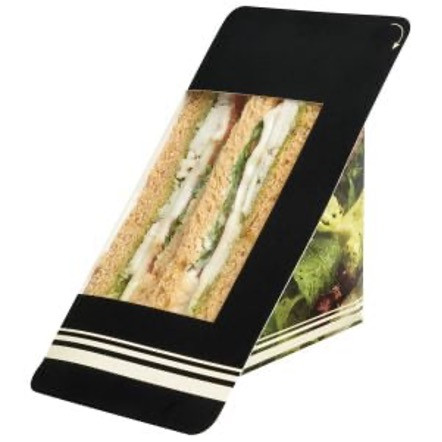
A typical MAP for a sandwich. This image by Colpac Packaging is used under fair use.
Also, for MAP to work, it’s important that the modified atmosphere be sustained. Therefore, leaks must be prevented and packaging materials with low gas permeability must be used.
For this reason, MAP often relies on plastic films which are excellent gas barriers but are not very environmentally friendly. Compostable and paper-based materials are friendlier but are more permeable, absorb moisture and have shorter shelf-lives. Thus, there is a trade-off between environmental impact and food waste.
Permeable materials allow liquids and/or gases to pass through them. Low gas permeability means that the material does not allow gas molecules to easily pass through it.
If you want to learn more about MAP, watch the following videos.