
User account menu

  • Log in
Home Next Engineers
  • About
    • Our Program
    • Our Leadership
    • Volunteer
    • What Do Engineers Do?
    • Becoming an Engineer
    • FAQs
    Building a better world
    We are increasing the number of engineering innovators and leaders who will make what’s next for the world even better.
    Group of students
  • Programs
    • Engineering Academy
    • Engineering Camp
    • Engineering Discovery
    • Engineering at Home
    Driving change
    Inspiring the next generation of engineers to build a more creative, innovative, sustainable world.
    Engineering students
  • Locations
    • Bengaluru, India
    • Cincinnati, OH
    • Greenville, SC
    • Johannesburg, S.A.
    • New York Capital Region
    • Staffordshire, U.K.
    • Warsaw, Poland
    • Global Discovery
    GE businesses around the world are inspiring young minds
    Find city profiles, activities and how to join.
    Aim high
  • News
    Latest news & updates
    Read all news, updates, and happenings from the Next Engineers initiative.
    A group of students and teacher
  • Log in

Main navigation

  • About
    • Our Program
    • Our Leadership
    • Volunteer
    • What Do Engineers Do?
    • Becoming an Engineer
    • FAQs
  • Programs
    • Engineering Academy
    • Engineering Camp
    • Engineering Discovery
    • Engineering at Home
  • Locations
    • Bengaluru, India
    • Cincinnati, OH
    • Greenville, SC
    • Johannesburg, S.A.
    • New York Capital Region
    • Staffordshire, U.K.
    • Warsaw, Poland
    • Global Discovery
  • News
  • Log in

Cities navigation

GE businesses around the world are inspiring young minds
Find city profiles, activities and how to join.
Aim high

Inspiration navigation

Driving change
Inspiring the next generation of engineers to build a more creative, innovative, sustainable world.
Engineering students

News navigation

Latest news & updates
Read all news, updates, and happenings from the Next Engineers initiative.
A group of students and teacher

Resources navigation

Explore all resources
Find the tools that you need to run a successful Next Engineers program, including communication collateral and templates, student and volunteer outreach materials, student activity guides, engineering challenges, and Monitoring & Evaluation resources.
Two male engineering students at a table in a classroom smiling. Photo by Jeswin Thomas on Unsplash.
Building a better world
We are increasing the number of engineering innovators and leaders who will make what’s next for the world even better.
Group of students
Challenge Yourself
Find activity guides and resources to help you as students, parents, and teachers stay curious and build worlds that haven't even been thought of yet.
Challenge yourself
Measuring Impact
Partners and volunteers can explore real-time data on each Next Engineers program to see the difference they’re making in their communities.
Facilitator Amber showing the whitebaord
Extreme Machine Banner
  • DIY
Extreme Machine
Extreme Machine Part 3: Squeeze Harder
Nerd Out
PDF Download
What is Compression Ratio?

As we saw in Part 1 of this series, the air entering the core of a jet engine does not go straight to the combustion chamber. Instead, it is first highly compressed. Compression is one of the most powerful ways engineers have to improve jet engine efficiency.

Compressing the air as much as possible does three important things:

  1. It improves combustion efficiency: Dense, compressed air allows fuel to burn more completely. There is more oxygen contained in a smaller volume.
  2. It increases thermal efficiency: According to thermodynamics, higher compression lets the engine extract more useful work from the same fuel. This is called thermal efficiency.
  3. It reduces fuel consumption: More energy is converted into thrust instead of wasted as heat.

In simple terms, better squeezing, leads to better burning, which results in better efficiency.
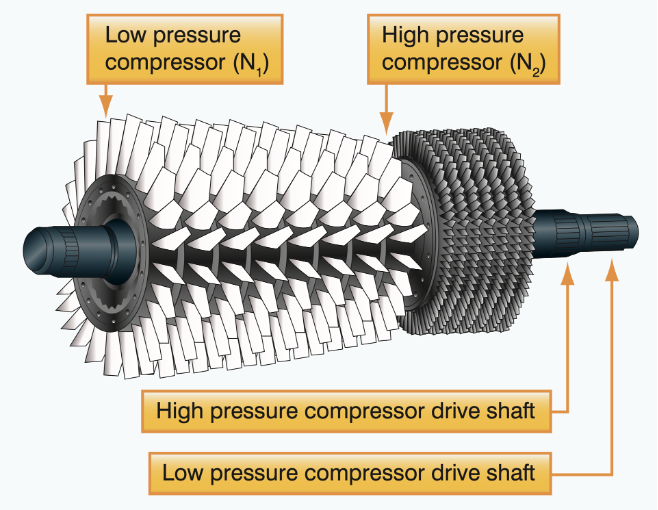
Diagram of a 2-stage compressor
This image is credited to the Federal Aviation Administration and is in the public domain

The amount of “squeeze” provided by the compressor is called the pressure ratio (PR). It is simply the ratio of the air pressure leaving the compressor to the air pressure entering it or

\[ PR = \frac{P_{out}}{P_{in}}=P_{out}:P_{in} \]

A PR of 20:1 means the air pressure is increased 20 times (it is 20 times greater when exiting the compressor than when entering). Modern GE Aerospace engines exceed 25:1 – levels that would have seemed impossible decades ago.

know primary
Thermal Efficiency

Thermal efficiency is a measure of how effectively the engine converts the chemical energy in the fuel into useful mechanical work (thrust). It is typically expressed as a percentage of fuel energy not wasted as heat.

Thermal efficiency is given by

\[ \eta = \frac{1}{(P_{out} / P_{in} )^{\left(\gamma-1\right)/\gamma}} \]

where $ P_{out} $ and $ P_{in} $ are the pressure of the air exiting and entering the compressor respectively.

All you need to see is that the greater this ratio (or the greater $ P_{out} $ is), the greater the overall efficiency.

How Jet Engines Compress Air

Compression happens in stages, not all at once. Trying to compress all the air at once would stall the flow and shut the engine down. A compressor consists of a series of rotating blades (rotors) alternating with stationary vanes (stators). Each pair of rotors and stators adds a small pressure increase. Together, dozens of these stages multiply the pressure dramatically.

A modern turbofan has 2 distinct compressor sections:

  • The low-pressure compressor (LPC): This is immediately after the fan and has fewer stages (normally about 3 - 6) and larger diameter blades. It provides a moderate pressure increase (2:1 to 4:1) at low speeds (between 3,000 and 5,000 RPM). Its main job is to precondition the air to increase the efficiency of the high-pressure compressor.
  • The high-pressure compressor (HPC): This has more stages (normally about 8 - 14) and smaller diameter blades. It spins faster (between 10,000 and 15,000 RPM) and can achieve PRs of 15:1 to 25:1.

This design lets the LPC spin slower (at a similar speed to the fan) while the HPC spins faster for peak efficiency, enabling overall PRs of 40:1 to 50:1.

Have a think primary
Overall Compression Ratio

If you also consider the increase in pressure provided by the huge fan in modern turbojet engines, the overall increase in pressure between the air entering the engine and that entering the combustion chamber is even greater. This is called the overall compression ratio (OCR). The GE9X boasts an OCR of 60:1 with a compressor PR of 27:1.

Take a Closer Look
Compressors - Turbine Engines: A Closer Look

Take a closer look at a real life jet engine compressor in action.

Adding More Squeeze

Increasing the PR sounds simple – just add more stages and make the blades spin faster. However, as we have come to expect, this is no free lunch. Each increase introduces new problems.

  • Heat builds up quickly: Compressing air raises its temperature. At very high compression, air exiting the compressor is extremely hot and places the materials under enormous thermal stress. Too much heat reduces component life and reliability. Therefore, component cooling becomes essential.
  • Aerodynamic stability decreases: When air gets highly compressed, it is more prone to flow separation, compressor stall, and surge (a violent reversal of airflow). Preventing this requires very precisely shaped rotor blades, stator vanes that can be adjusted and advanced control systems to make these adjustments. This all adds cost and complexity to the design.
  • Mechanical loads increase: Higher compression needs faster spinning blades which, as we saw in part 2, greatly increases the centripetal forces (remember that $ F=m\omega^2 r $). Therefore, the compressor blades experience huge forces trying to tear them apart every second the engine runs. This requires making blades that are light, strong, and fatigue-resistant - a major materials engineering challenge.
  • Manufacturing precision matters more: To more effectively achieve high compression ratios, the gaps between rotor blades and stator vanes must be as small as possible. All the components must also be perfectly and uniformly shaped. Tolerances need to be measured in fractions of a millimeter and advanced manufacturing and quality control are essential but time consuming and expensive.

But engineers don’t maximize compression blindly. At some point, adding more stages adds too much weight, more intricate blade designs with tighter tolerances raise costs and complexity, and higher temperatures reduce component durability. Therefore, the best design is not actually the highest PR design - it’s the optimum PR design.

Did you know primary
Faster than Sound

The tips of the high-pressure compressor blades in many GE Aerospace engines travel faster than sound. For example, the blade tips in the GE90 compressor travel at between Mach 1.2 and Mach 1.6. The speed of sound is Mach 1.

Some Ingenious Solutions

GE Aerospace engineers have developed many ingenious ways of producing compressor blades able to withstand the enormous pressures, high temperatures, and punishing mechanical stresses that come with ever greater PRs.

1. Blisks

Instead of making the rotors as a central hub with many attached blades, rotors are made as blisks. “Blisk” is a portmanteau of "blade" and "disk" and is a rotor disk and blade machined out of a single piece of material.
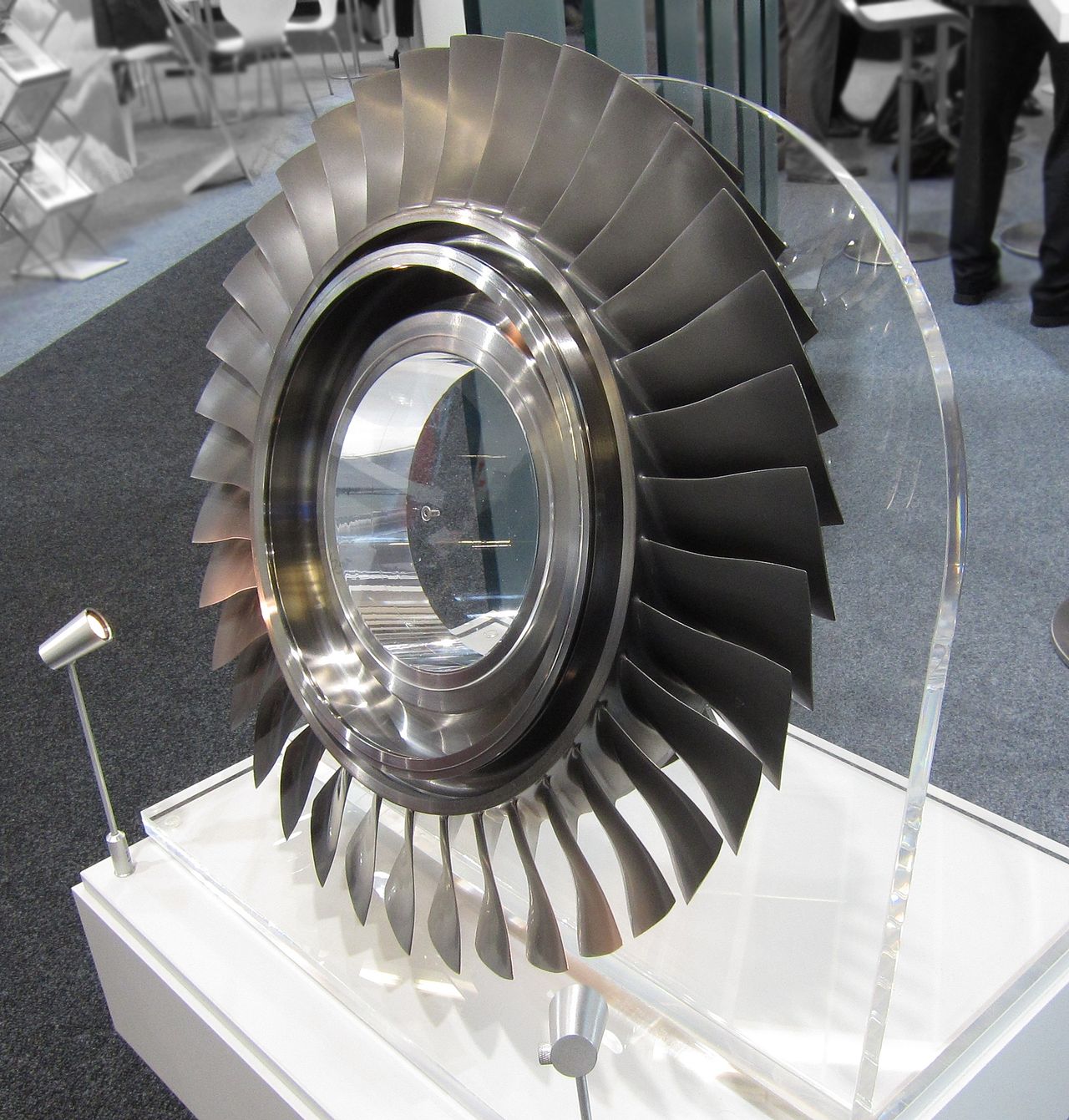
A compressor blisk
This image is credited to Olivier Cleynen and is leased under a CC-BY-SA licence

The benefits of blisks include weight savings (there is no need for blade attachments), improved aerodynamics (there are no gaps between the blades and the hub), and better reliability (there is far less chance of a blade detaching). But there is a trade-off. If one blade is damaged, the entire blisk may need to be replaced.

Did you know primary
Linear Friction Welding

One of the clear downsides of blisks is that if one blade gets damaged it can be hard to just replace that one blade. But linear friction welding makes this possible.
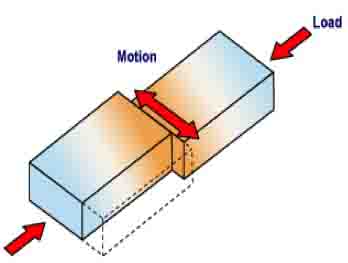
This is a technique of fusing 2 pieces of metal by pushing them together very firmly and then vibrating one of the pieces to create friction and heat. This causes the pieces to fuse without melting and avoids the defects that melting produces.

Watch a weld

Learn More
Blisk Manufacturing

See how a blisk is machined out of a single piece of titanium.

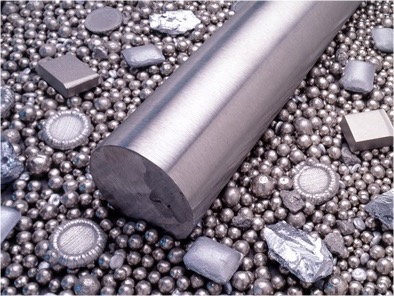
2. Titanium Aluminides

Secondly, engines like the GEnx, have compressor blades of titanium aluminide (TiAl). TiAl has several advantages over traditional titanium alloys. It is lighter (4 g/cm3 vs 4.5 g/cm3), more heat-resistant (up to 800°C vs about 550°C), stiffer and reacts less with oxygen and nitrogen at high temperatures, meaning that the compressor can run faster for improved PRs.

However, titanium aluminides are more brittle than traditional titanium alloys and need more complex and expensive manufacturing techniques.

Read the article The Evolution of Compressor Blades: From Steel to Titanium to Ceramic Composites to learn more.

Did you know primary
Titanium Aluminides

Titanium aluminides are classified as ordered intermetallic compounds, which means they form when atoms of two or more metals (in this case titanium and aluminium) combine in a fixed ratio to produce a crystalline material with a different structure than either of the individual metals.
Dive deeper

Engineering Trade-offs

As we have seen increasing the PR in a jet engine improves fuel efficiency and boosts overall engine performance. But this comes at the expense of increased heat, mechanical stress, and expensive manufacturing and operational complexity. Each extra unit of compression delivers diminishing returns. An engine that is slightly less efficient but significantly more durable can still save airlines millions of dollars over its lifetime.

In the next article, we’ll move to the hottest part of the engine where engineers push combustion temperatures far beyond what materials should be able to tolerate but find ways to make them survive anyway.

Extreme Machine

Part 2: Must Move More Air

Read more

Extreme Machine

Part 4: Getting Hotter

Read more


See All Activities
Connect

Want to know more or how to get involved? Are you an aspiring engineer or do you know one? We want to hear from you. Send us your questions and follow us on social media:

Contact us: NextEngineers@fhi360.org

Follow GE Aerospace
Instagram LinkedIn X YouTube

Follow GE VERNOVA
Instagram LinkedIn X YouTube
A groups of students

Footer menu

  • About
  • Inspiration
  • Cities
  • News

Footer secondary

  • Terms of use
  • Privacy Policy
  • Cookie Policy
  • Research Study Notice
  • Next Engineers Privacy Notice
  • GE Aerospace
  • GE Vernova
© 2026 FHI360