


Extreme Machine
Extreme Machine Part 1: How a Jet Engine Works
Nerd Out




Global air travel has become so commonplace that we seldom stop to think about the amazing thing that it is – how it’s possible that enormous metal objects carrying hundreds of people at a time routinely travel thousands of miles without incident.
Right at the heart of what makes this all possible is the modern jet engine (technically, the turbofan engine) – one of the most extreme machines ever built. A single GE90 turbofan, for example, can produce over 400,000 Newtons (N) of thrust, survive temperatures hotter than molten lava, and operate flawlessly for hundreds of thousands of hours, ensuring that people get where they’re going safely and reliably.
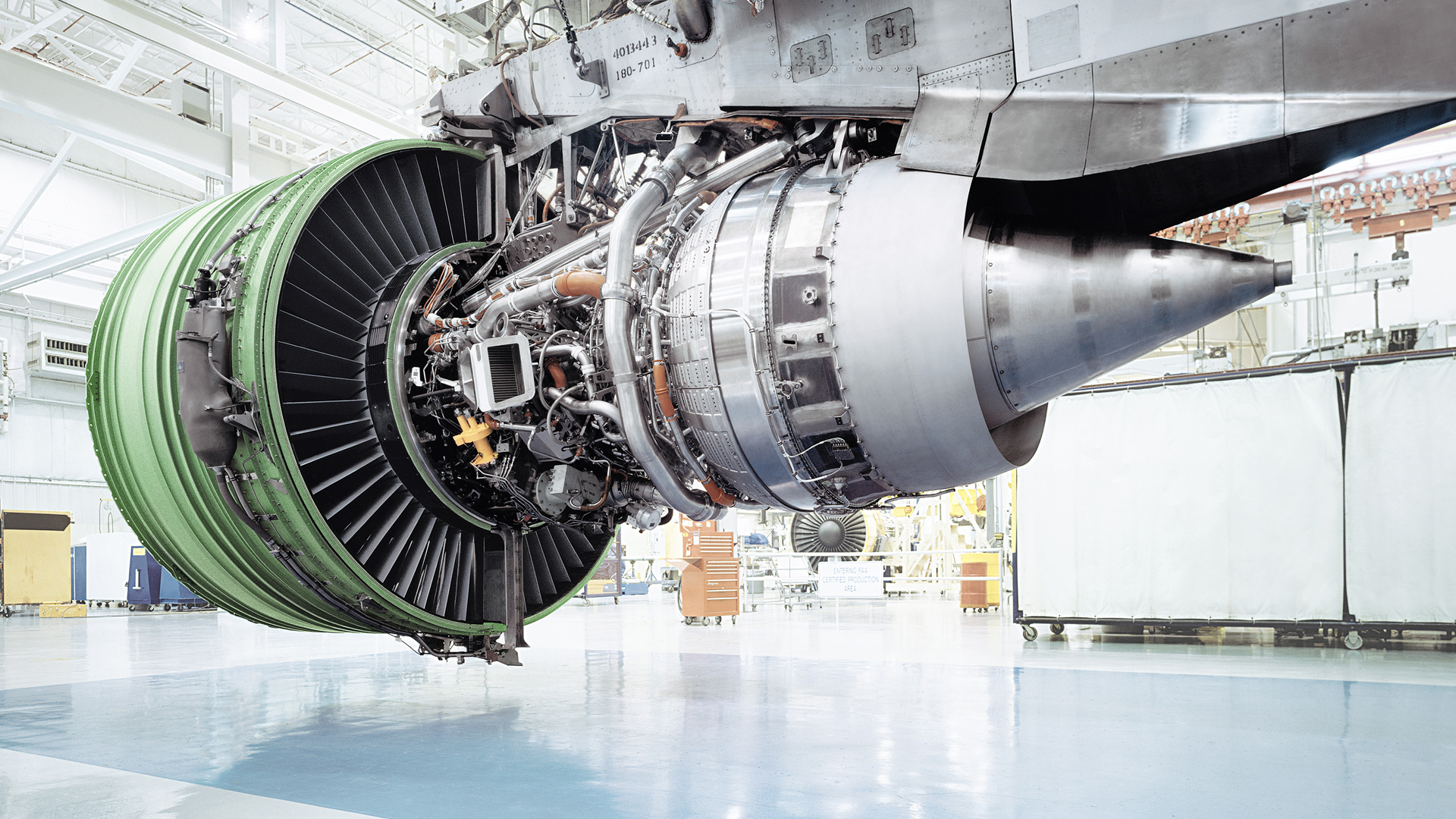
A turbofan is a type of gas turbine jet engine that uses a large front fan, powered by the engine's core gas turbine, to move a huge amount of air. Most of the air bypasses the core with only a small portion going through the engine to be combusted. Turbofans produce a large amount of thrust efficiently, making them ideal for modern commercial airliners.
So how does a turbofan engine actually work? And why is making it more efficient such a hard engineering problem?
At its simplest, a jet engine does one thing: it pushes air backwards to push the aircraft forwards. This is Newton’s Third Law in action. If you accelerate a mass of air in one direction, you experience a force in the opposite direction. That force is called thrust.
Early jet engines pushed a small amount of air very fast. Modern turbofan engines do it differently – they trade speed for mass, which turns out to be far more efficient.
Early jet engines pushed a small amount of air very fast. Modern turbofan engines do it differently – they trade speed for mass, which turns out to be far more efficient.
A turbofan engine has two main airflow paths:
Here’s the surprising part. It might seem silly to waste all that bypass air. However, most of the thrust in a modern turbofan (80% - 90%) comes from the bypass flow, not the exhaust jet from the core. That big fan at the front is what creates the bypass flow and hence most of the engine’s thrust.
The ratio of bypass to combustion air is called the bypass ratio (BPR). Some modern turbojets, like the GE9X, achieve bypass ratios of 10:1 (10 kg of air goes around the core for every 1 kg that goes through it). Generally speaking, the higher the bypass ratio, the greater the engine’s efficiency and the quieter it is.
There are 4 key parts of a turbofan engine:
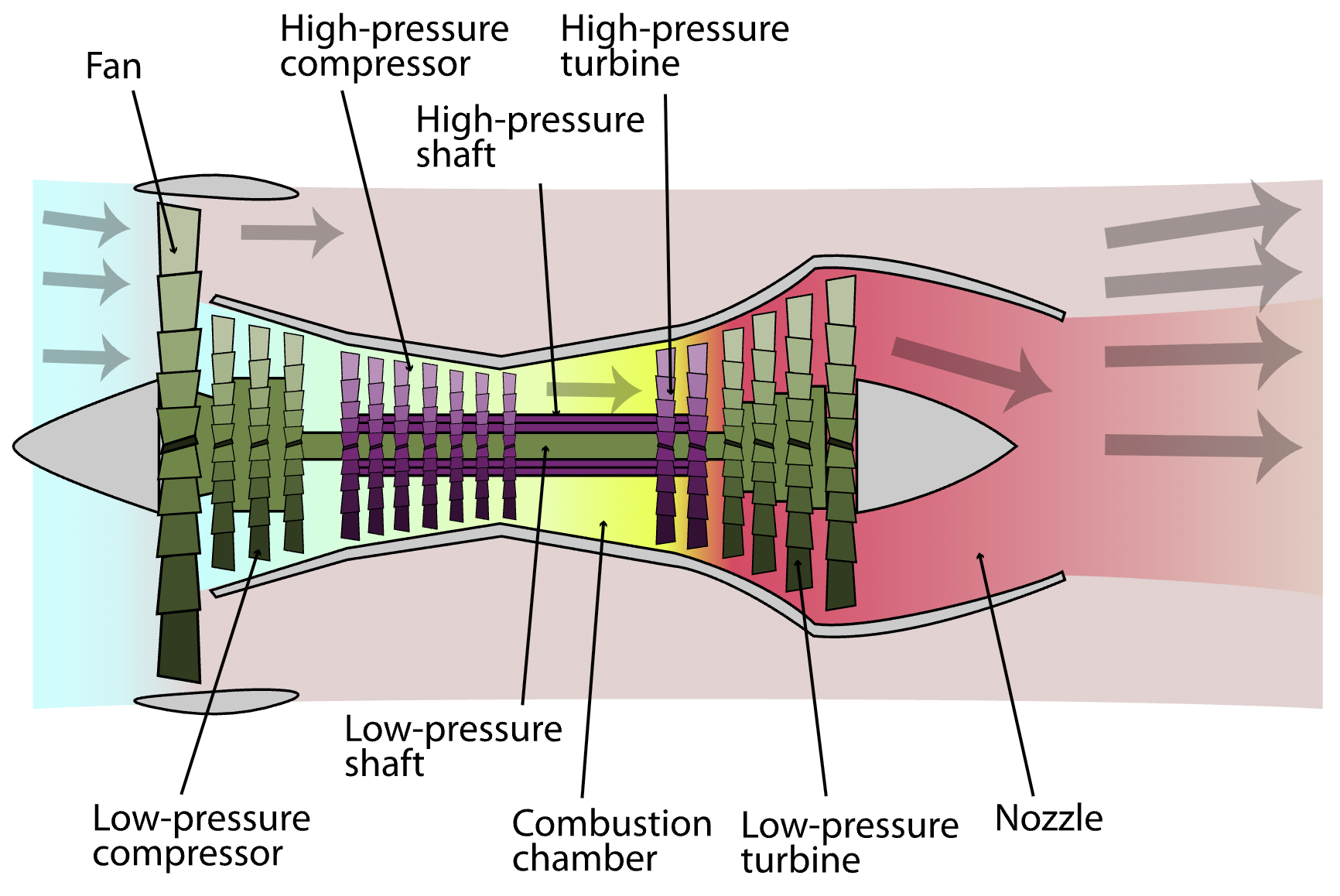
This continuous, 4-stage cycle is often summarized as "suck, squeeze, bang, blow".
This is the simplified equation to calculate the thrust of a jet engine:
\[ F_{thrust}=m×(V_e-V_0)
\]
where
\[ m=\text{mass of air flow}\]
\[V_e=\text{exit velocity of air}\]
\[V_0=\text{intake velocity of air}\]
By doubling the mass of air being moved, we can double the thrust of the engine.
Watch these videos for an excellent summary of how modern turbofan engines work.
If turbofans are so efficient and the greater the bypass ratio the greater the efficiency, why not just make them ever bigger? Afterall, the perfect engine would have high thrust, great efficiency, and long life, all while being quiet.
Well, because engineering, just like life, is all about trade-offs. Improving one of these things often hurts another.
Here are some of the competing goals engineers face:
Therefore, there is no “perfect” jet engine. Every design is a balance between three crucial factors – performance, cost and reliability. These are almost always in conflict, meaning that engineering is not about maximizing everything at once. It is about optimizing – about making the best possible decisions under real constraints.
For example, GE Aerospace has made thousands of small, incremental changes to their jet engines over decades. Each generation, like the GE90, through to the GEnx, and the GE9X represents successive improvements in design, materials, manufacturing, aerodynamics, cooling, and overall system integration.
In the next articles, we’ll explore three of the best ways engineers have and continue to improve turbofan engines—and the difficult trade-offs each one brings, including increasing the bypass ratio, increasing the air compression, and increasing the combustion temperature.
For now, visit The Parts of a Gas Turbine or watch the following videos for a more in-depth look at how turbojet and turbofan engines work.
Dive into the mechanics and science behind the turbojet engine and learn about the thermodynamic principles that make an engine run.
Learn about the crucial concept of bypass ratio and uncover why turbofans are the preferred choice for commercial airlines.
Learn about the key differences between turbojet and turbofan engines.
Learn about some of the ways jet engines have evolved to become much more powerful and much more efficient.