


Pi Day
Pi Day: Everywhere Pi
Nerd Out




The famous mathematical constant pi (π) is famous for a reason. It is incredibly useful. It is needed anytime one deals with circles, cylinders, or spheres. This does not just include calculating areas and circumferences. It is also needed to calculate circular or angular velocities and accelerations (how quickly things spin and how quickly their rate of spin is changing).
In fact, π is needed when working with curves of many kinds, not just circles, which makes it indispensable to civil and mechanical engineers as well as architects.
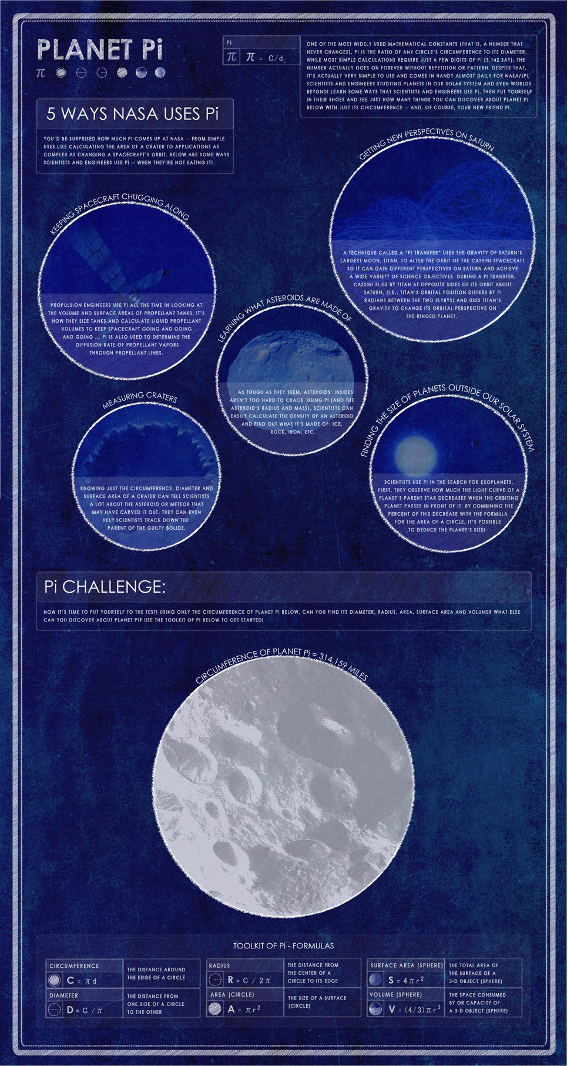
Pi underpins the global positioning system (GPS) since the earth is close to a perfect sphere. Indeed, NASA scientists use π all the time when calculating rocket trajectories and orbits.
Electrical engineers rely on π to help them calculate the current and voltage in different electronic circuits containing inductors and capacitors.
Pi can be used to describe waves of all kinds, from those on a beach to light moving through space. It is also needed to describe the behavior of sub-atomic particles in quantum physics. Physicists at the Large Hadron Collider (LHC) use π all the time, not only because the collider is circular, but also because of the shape of the orbits of electrons and other sub-atomic particles.

Pi was also initially involved in the calculation of the acceleration due to gravity on earth and the definition of a meter. This involved devising a pendulum that completed a swing every two seconds. Because of this, it turns out that $ g≈\pi^2$.
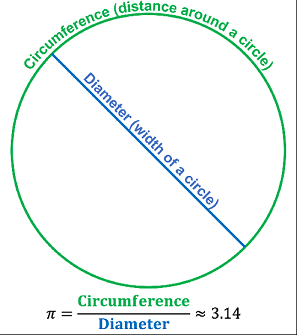
Pi (represented by the Greek letter π) is the ratio of the length of a circle’s circumference to its diameter and has a value of approximately 3.14.
Learn more about Pi in part 1 of this Nerd Out series.
But π can also be quite playful. It turns up in other less serious but no less surprising ways. Watch the following videos to learn more.
This video explores how the number 5 and π are related.
This is a long and fairly technical video that explores how π turns up in the distribution of prime numbers.
This video describes how π turns up in the number of times two sliding blocks collide with each other on a perfect frictionless surface.
This video solves the sliding block problem introduced in the video previous.
Euler proved that the infinte sum $1+\frac{1}{4}+\frac{1}{9}+\frac{1}{16}+\frac{1}{25}+⋯=\frac{\pi^2}{6}$. This video provides a reasonably easy to understand geometric answer to why this is the case.
What other specific or surprising uses of π can you find? Do some research and share what you find at #NextEngineersDIY.